| Past exhibitions
 |
 |  |
 |  |  |
WISTFUL MEMORY - 11.3. - 2.5 Rooms 1, 3 and 4 |
 |
Amelie von Wulffen
Birgir Snæbjörn Birgisson
Helgi Hjaltalín Eyjólfsson
Helgi Þorgils Friðjónsson
Wistful Memories comprises the works of four artists who deal with the perseverance of recollections. Due perhaps to the literary aspect of reminiscences we tend to forget the glance, the image which the memory catches as a vague flash, without mediation or narrative. These moments seem to characterize the works of Amelie von Wulffen and force themselves onto the actual by deforming the space with similar aggression as in Carl Fredrik Hill’s spatially distorted drawings or Leonardo employed in the play of vanishing points in his drawing of the Magi, which also was left unfinished, as the spectator might be left to think before many of von Wulffen’s paintings. On the other hand Birgir Snæbjörn Birgisson sides literally with literature by rewriting, word by word, information on the prostitutes in Paris in the 19th century. Helgi Hjaltalín Eyjólfsson dwells by a theme, which is constantly before his eyes and marks his surroundings in a memorable way, while being virtually invisible for those who do not know the area. For his namesake, Helgi Þorgils Friðjónsson, wistful memories are inherent in the apparition of the commonplace, as in the cornucopia of Dutch still lives from the 17th century, of tables filled with food, but nowadays appear in the broadcast of Icelandic news as information on the value of fishery by trawlers and boats and the prospect of catch. This is how the trivial souvenir, becomes a wistful comedy with the passing of time.
The German Embassy supported the exhibition. |
 |
 |
 |  |
WORKPLACES OG REAL MEN - 11.3. - 11.4. 2010 Room 2 |
 |
Ívar Brynjólfsson
Ívar Brynjólfsson’s career as a photographer is more diverse than that of most of his colleagues. For a long time he has turned out distinct, beautiful photographs for the collections of the National Museum of Iceland, hence his pictures of workplaces of males must amaze his admirers. Van Gogh painted his Sunflowers on either side of Madame Roulin, who fiddles with her rosary in a rocking chair. This is how he conceived of a triptych, which was to be printed for the fishermen to have in the forecastle of the Breton cutters in the waters around Iceland. All males seem to need an altar-piece and these Brynjólfsson finds in the office corners of the workshops of the journeymen or mechanics. These are not pious women with a rosary, but women nevertheless. |
 |
 |
 |  |
CARNEGIE ART AWARD 2010 - 9.1. - 21.2. 2010 Rooms 1-4 |
 |
The Carnegie Art Award is among the largest art prizes in the world. This year the main award, a prize of one million Swedish crowns, was awarded to the Icelandic artist Kristján Guðmundsson. His works will be exhibited along with works by twenty two other selected Nordic artists at Tha National Gallery of Iceland.
ARTISTS
Kjersti G. Andvig -NO, Kristján Guðmundsson-IS, Torben Ribe-DK, Anastasia Ax-SE, Kristina Jansson-SE, Sigrid Sandström-SE, Tone Kristin Bjordam-NO, Sergej Jensen-DK, Astrid Sylwan-SE, Milena Bonifacini-DK, Camilla Løw-NO, Egill Sæbjörnsson-IS, A K Dolven-NO, Jukka Mäkelä-FI, Marie Søndergaard Lolk-DK, Saara Ekström-FI, Ylva Ogland-SE, Marianna Uutinen-FI, Mads Gamdrup-DK, Jorma Puranen-FI, Hannu Väisänen-FI, Felix Gmelin-SE, Seppo Renvall-FI
THE JURY - Here THE PRIZE WINNERS - Here THE ARTISTS - Here |
 |
 |
 |  |
SVAVAR GUÐNASON - 31.10. 2009 - 03.01. 2010
|
 |
The exhibition is a retrospective of the works of Svavar Guðnason. Guðnason became one of Iceland’s most prominent painters through his close connection with Danish abstract art between 1936 and 1946. At that time Danes were leading in Europe as spontaneous abstract artists.SVAVAR GUÐNASON - Article by Halldór Björn Runólfsson |
 |
 |
 |  |
HIDDEN TREASURE: TREASURES IN PUBLIC POSSESSION? - 10.7.-18.10. 2009 Rooms 1-4 |
 |
An exhibition of works from the collections of the three state banks, Kaupþing, Landsbanki Íslands and Íslandsbanki, and also works from the collection of The National Gallery of Iceland. The collections of the state banks consist of roughly 5.000 works and in The National Gallery of Iceland there are about 10.000 works. Many questions concerning the future of the art collections of the banks have as yet not been answered, but this exhibition aims at shedding 94 works from the collections of the state banks and ca. 50 from the collection of The Icelandic National Gallery; these include paintings, lithographies, photographs, drawings, textile works, sculptures and installations. The oldest work of the exhibition is from 1881, by Þóra P. Thoroddsen.HIDDEN TREASURES IN PUBLIC POSSESSION? by Halldór Björn Runólfsson |
 |
 |
 |  |
HRAFNKELL SIGURÐSSON - 15.5 - 28.6. 2009 Rooms 2, 4 |
 |
HRAFNKELL SIGURÐSSON
An exhibition at the National Gallery of Iceland in connection with the Reykjavík Art Festival 2009.
Hrafnkell Sigurðsson (b. 1963) is among the best Icelandic photo artists, who uses the medium as means of conceptual expression.
THE LOGIC IN THE WORKS OF HRAFNKELL SIGURÐSSON by Halldór Björn Runólfsson director |
 |
 |
 |  |
KRISTJÁN GUÐMUNDSSON - 15.5. - 28.6 2009 Rooms 1, 3 |
 |
KRISTJÁN GUÐMUNDSSON
An exhibition at the National Gallery of Iceland in connection with the Reykjavík Art Festival 2009.
Kristján Guðmundsson (b. 1941) was among the founders of the seminal Gallery SÚM, in 1969, and of the Living Art Museum a decade later. He has a long record as a leading artist and his works are particular for their conceptual directness and clarity.KRISTJÁN GUÐMUNDSSON´S POETICS by Halldór Björn Runólfsson director
|
 |
 |
 |  |
ÞÓRÐUR BEN SVEINSSON - April 18th - June 28 2009 2nd floor |
 |
On the second floor some of Þórður Ben Sveinsson’s works on urbanism and architecture can be seen, under the titles Urban Nature, from 1981 to 2005. The largest of these works is the acrylic painting, Urban Nature from 1984, which gives a good idea of the artist’s development of a “garden house”, in connection with his “warmed street” concept, both of which are central terms in his architectural vocabulary. Þórður Ben Sveinsson is a good example of an artist who can‘t be categorized by a single formal definition. |
 |
 |
 |  |
SEVERAL FRIENDS - February 13th - May 5 th 2009 Rooms 1, 3, 4 |
 |
The exhibition sheds light on the period in Icelandic art when formalism, confronted by informal values, retreated and other attitudes started to invade the art scene in the second half of the 20th century. The focus is cast on the arrival in Iceland of the Swiss artist Dieter Roth and the parallel development which took place among several young artists who new each other and met regularly. Their mutual impact and the influence they had on Icelandic art is at the core of the exhibition.
The works in the exhibition span the period from the mid 20th century to our times and are by: Arnar Herbertsson, Björn Roth, Dieter Roth, Erró, Hreinn Friðfinnsson, Hörður Ágústsson, Jóhann Eyfells, Jón Gunnar Árnason, Kristján Guðmundsson, Magnús Pálsson, Magnús Tómasson, Róska, Rúrí, Sigurður Guðmundsson, Sigurjón Jóhannsson and Þórður Ben Sveinsson. Hilmars Oddsson’s documentary on the life and art of Dieter Roth will be shown in connection with the exhibition.
Most of the works in the exhibition are from the collection of the National Gallery but a good deal comes from the collection of the Living Art Museum. The National Gallery is grateful for the cooperation with its personnel.
Curators: Björn Roth, Halldór Björn Runólfsson and Sigríður Melrós Ólafsdóttir.
Exhibition design: Ívar Valgarðsson.
|
 |
 |
 |  |
The Spare - 26.3. - 15.4. 2009
|
 |
The Sphere - furniture and designed objects from 1962.
The Sphere was a furniture shop in Reykjavík, established in April 1962.
Its aim was to sell low-priced, original furneture and art objects. The
founders of The Sphere were Manfreð Vilhjálmsson, Magnús Pálsson and
Magnús Jóhannsson. Dieter Roth is said to have been its main
protagonist, creating - as many other artists in the exhibition
"Several Friends", now at the National Gallery - an array of important
artistic objects to be sold there.
Furniture and photos of The Sphere will be on display at the Café of
the National Gallery of Iceland.
|
 |
 |
 |  |
MOVING PICTURES: Video tapes in the wake of Icelandic multimedia - December 12 2008 – February 1st 2009
|
 |
A new exhibition of video works by three Icelandic women, Ásta Ólafsdóttir (b. 1948), Sigrún Harðardóttir (b. 1954) and Steina (b. 1940), has been opened in the National Gallery of Iceland. Ólafsdóttir’s work, It Continues from 1983, deals with mixed feelings and reflections of past events and encounters. The work was purchased by the museum in 1988. Harðardóttir’s work, Digital Self-portrait from 1985 – is the result of a seminar under the guidance of Steina and Woody Vasulka at the Monte Video Multimedia Centre in Amsterdam. Digital Self-portrait was shown on Chanel 2, a year before it was purchased by the National Gallery, in 1988. Steina’s work, Noisefields, 1974, Orbital Obsession, 1977, and Lilith, 1987 show successively her evolution. Noisefields is considered by many among the most complete merging of sound and picture in the entire history of video art. Orbital Obsession is a black and white journey into the technological wonderland of Steina and Woody Vasulka’s studio in Buffalo. Lilith was Adam´s other companion, naughty and unpredictable. Here digitalization has entered the field and the National Gallery purchased this masterpiece of Steina in 2007. Curator: Halldór Björn Runólfsson and his team. |
 |
 |
 |  |
LOVE AT FIRST SIGHT: New Acquisitions from the Würth Collection -
|
 |
LOVE AT FIRST SIGHT: New Acqouisitions from the Würth Collection
11.10. 2008 - 28.1. 2009
The private collection of the German industrialist Reinhold Würth has grown enormously during the last decades. It is now considered one of the largest private collections in Europe in terms of modern and contemporary art. The exhibition displays the recent acquisitions from this important private collections, where Impressionist works to contemporary German and international art will be on display.
Museum Würth
Würth á Íslandi is the main sponsor for the exhibition. |
 |
 |
 |  |
SHIRIN NESHAT - 25.9.-2.11. 2008
|
 |
SHIRIN NESHAT
Exhibition of videoworks by the Iranian artist Shirin Neshat in room 2. The exhibition is a part of Reykjavík International Film Festival (RIFF).
The exhibition has been extended until Sunday November 2nd 2008.
Shirin Neshat was born in 1957 in Qazvin, Iran. She lives and works in New York. In her work, both photographic and video, she focuses on the situation of people in Iran, and especially women.
Shirin’s one-woman shows include exhibitions at Franklin Furnace, New York (1993); Centre d’Art Contemporain, Fribourg (1996); Museum of Modern Art, Ljubljana (1997); Whitney Museum of American Art at Philip Morris, New York; Tate Gallery of Modern Art (1998); Art Institute of Chicago (1999); Serpentine Gallery (2000); Barbara Gladstone Gallery (2001); ARoS Art Museum, Denmark (2002); Castello di Rivoli, Turin (2002); Hiroshima City Museum (2005); Espoo Museum of Modern Art, Espoo, Finland (2006); Galleria Filomena Soares, Lisbon (2007); Gladstone Gallery, New York (2008).
Photographic and video works by Shirin Neshat have been shown at many international exhibitions, such as the tenth Biennale of Sydney (1996); the fifth Istanbul Biennale and the Johannesburg Biennale (1997); Museum of Contemporary Art, Chicago (1999); Exploding Cinema, Museum Boijmans Van Beuningen, Rotterdam; Heavenly Beings, Kunsthalle Düsseldorf; Zeitwenden, Rheinisches Landesmuseum, Bonn, in collaboration with Kunstmuseum, Bonn; SITE Santa Fe, New Mexico; La Ville, le Jardin, la Mémoire (1998, 2000, 1999), Académie de France, Villa Medici, Rome; Venice Biennale (1999); Corpo Chimico, Cá di Fra, Milan (2000); Galerie Farschou, Copenhagen (1986-2001); Visions from America, Whitney Museum of American Art, New York (2002); Moving Pictures, Guggenheim Bilbao (2003); Non Toccare La Donna Bianca, Fondazione Sandretto Re Rebaudengo per l’Arte, Turin (2004); Translation, Palais de Tokyo, Paris (2005); Kapital, Kent Gallery, New York (2006); After the Revolution: Women Who Transformed Contemporary Art, Dorsky Gallery Curatorial Programs, Long Island, New York (2007).
In Rapture (1999) we see a group of men walking toward the camera along the streets of a Middle Eastern city. We also see a group of women dressed in black, who walk towards the sea shore, where several of them board a small boat and sail out to sea. The men wave to the women as they sail away, either signalling them to return, or bidding them goodbye. The work clearly illustrates the separation of the sexes in Islamic culture. In Rapture the men are depicted among public buildings, while the women are identified with the land and sea.
Turbulent (1998) shows men singing in public, while the women sing wordlessly, and alone.
In Passage (2001) Shirin Neshat alternates images of a group of men on a beach apparently carrying the body of white-clad woman with women in a circle, digging a hole with their bare hands. Nearby is a young girl arranging stones in a circle. As the men approach the circle of women, fire flares up behind the child, across the barren landscape and into the distance, behind the men and women in the foreground. The works are reminiscent of a ritual, in this case a rite which seems to presage fundamental change in the interaction of men and women.
Zarin (2005) depicts a women who has lost her mind after being forced into prostitution. She scurries from place to place in hope of reclaiming herself. She perceives males as monstrously deformed. Zarin shows us brothels and bathhouses, streets and mosques; she experiences an alienation which terrifies her.
Avigos, Jan. “Shirin Neshat,” Artforum, January 2006, pp. 220–221.
MacDonald. Scott, “Shirin Neshat,” A Critical Cinema 4: Interviews with Independent Filmmakers, University of CA Press, New York, 2005, pp. 323–324.
More: www.gladstonegallery.com
|
 |
 |
 |  |
FROM THE COLLECTION -
|
 |
At the annual summer exhibition at the National Gallery of Iceland theemphasis is on different periods in modern and contemporary Icelandic art. Each part of the exhibition focuses on a certain period in the short history of Icelandic art since it was first recognised as a profession, and various aspects of development in art are explored in light of social change.
P. Picasso, Jacqueline au ruban jaune, 1962
Rooms 1 & 2 - The Classical Values
Room 3 - Steina
Room 4 - Elín Hansdóttir |
 |
 |
 |  |
ART AGAINST ARCHITECTURE - 16.5. - 29.6. 2008
|
 |
A contribution of the National Gallery to the Reykjavík Arts Festival 2008
Art and architecture have always been on difficult terms, having a hard time understanding each other’s claim to unconditional attention and territorial authority. Most of the time it is art which has a weaker position, having to rely on architecture as its framework, protection and setting. This does not mean that art accepts its position unconditionally. It calls for surroundings as neutral as possible, which means as un-architectural as possible.
Still museums designed by architects continue to be built, leaving artists no other option than to confront their restraining rule. In this struggle the artist reflects the individual who rises against unconditional authority in whatever form it may appear, hoping to counter-balance it, or at least indicate a possible alternative. In this sense every exhibition reveals a latent conflict between artists and architects, but only a few unveil this fact explicitly.
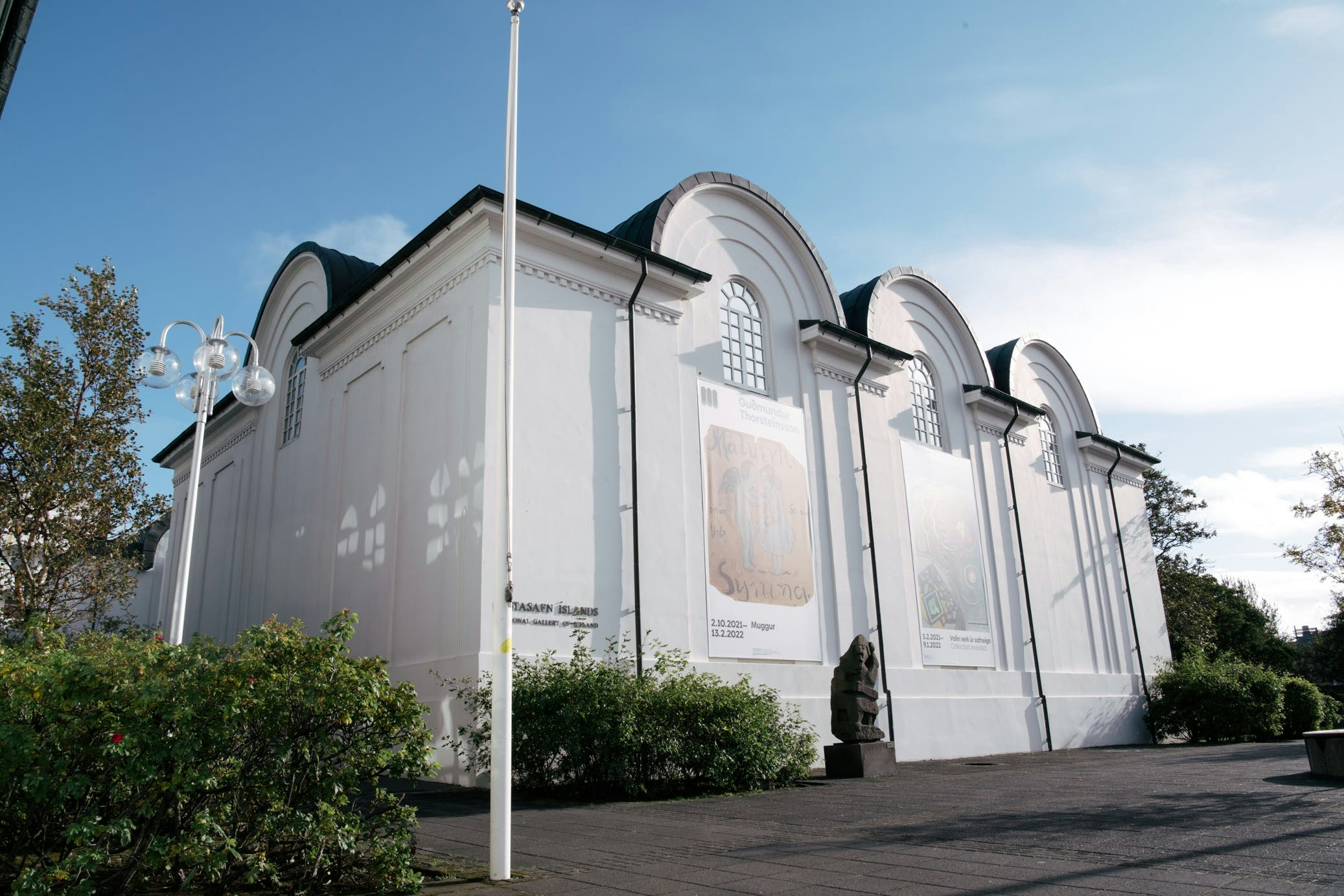
With its typical postmodernistic structure dating from the 1980s, the National Gallery of Iceland asks for a dialogue with artists brave enough to challenge its difficult structure. A better team than Monica Bonvicini, Elín Hansdóttir, Finnbogi Pétursson, Steina and Franz West is hard to find.
The catalogue will cover e.g. the ideas of Sant'Elia's Futurist architecture, Constant's New Babylon, Huizinga's Homo Ludens theory, Archigram and Archizoom, Koolhaas and the fact that Iceland's natural wilderness has recently been confronted by harnessing projects which jeopardize Europe's largest unspoilt territory.
Exhibition curator: Halldór Björn Runólfsson
Assistant curator: Harpa Þórsdóttir, Bryndís Ragnarsdóttir
Exhibition installation: Olga Bergmann, Úlfur Grönvold, Anna Hallin, Ólafur Ingi Jónsson
|
 |
 |
 |  |
Elín Hansdóttir -
|
 |
Elín Hansdóttir (b. 1980) is an Icelandic installator whose interactive media and space constructions create architecture within architecture by transforming actual surroundings and turning them into a psychological and phenomenological playground. She lives and works in Berlin. |
 |
 |
 |  |
Finnbogi Pétursson -
|
 |
Finnbogi Pétursson (b. 1959) is a sound and media artist who emphasises the immediate moment by juxtaposing art and electronic phenomena in a sophisticated synthesis of controlled and contingent tuning of his Minimalistic means. Pétursson lives and works in Reykjavík. |
 |
 |
 |  |
Franz West -
|
 |
Franz West (b. 1947) lives and works in Vienna, where in the early 1970s he became known for his singular portable plaster sculptures called “Adaptives”. He soon developed these bodily works into his renowned furniture installations transforming galleries, museums and public spaces into comfortable sociable settings. |
 |
 |
 |  |
Monica Bonvicini -
|
 |
Monica Bonvicini (b. 1965) is an award-winning multi-media installation artist born in Venice, who lives and works in Berlin. She dismantles the dictates of architecture by using materials like leather and velvet alongside concrete and steel, insisting on physical connection with her art. |
 |
 |
 |  |
Steina -
|
 |
Steina (b. 1940) is a pioneer of video art together with husband and collaborator Woody Vasulka. Together they founded “The Kitchen” in New York in 1971, the world’s foremost experimental video and audio space, before plunging into the technical core of the medium. Steina lives and works in Santa Fe, N.M. |
 |
 |
 |  |
STREYMIÐ - LA DURÉE - 23.2. - 1.5. 2008
|
 |
The exhibition “La Durée” is an attempt to bring two major Icelandic artists in conjunction with a foreign one, and thus modify the common habit which segregates the one from the other. The National Gallery of Iceland feels that this is the best way to confront an art culture which is both local and international, and acknowledges no mental restrictions, but sees itself as belonging in any place, any time, regardless of its origins. The content of the exhibition emphasizes unequivocally that “La Durée,” the duration of time, which the French philosopher Henri Bergson defined as the basis of human independence and formation, is a universal phenomenon without limits.
|
 |
 |
 |  |
EMMANUELLE ANTILLE - ROOMS 1, 2 |
 |
In 2003 Emmanuelle Antille represented her country at the 50th Venice Biennale, with her video work Angels Camp (2001-2003). Antille has long been renowned for her daring works focussing on the immediate environment, where the interaction of family and friends takes on the air of ancient rites; or youngsters make a place for themselves in suburban buildings like some exotic tribal group. Her work poses urgent questions about the state of culture and everyday life in modern society. |
 |
 |
 |  |
GABRÍELA FRIÐRIKSDÓTTIR - ROOM 3 |
 |
Gabríela Friðriksdóttir represented Iceland at the Venice Biennale in 2005 with her Versations Tetralogia, which attracted great attention for its remarkable combination of imagery, music and theatre. The Icelandic pavilion in the Giardini was transformed to resemble a barn, and visitors were invited into a journey through time in a mysterious mystical world, a place between sleeping and waking, where characters and actors from past centuries mixed with ghosts and monsters at a musical level. Thus the observer could pass from a cinematic progression to a musical experience in a symbolic world that took on a whole new form. |
 |
 |
 |  |
GUÐNÝ RÓSA INGIMARSDÓTTIR - ROOM 4 |
 |
In 2005 Guðný Rósa Ingimarsdóttir was one of those who represented Belgium at an exhibition of ARCO art in Madrid. Visitors became acquainted with her unique world, which is generally manifested silently and subtly through drawings which seem to come into being with neither beginning nor end. Her handling of the material in her most recent works is often based on many different layers of texture, brought out by a scalpel from beneath a net pattern, so that what lies beneath is revealed in an equivocal and ambiguous manner, to disappear once more inwards into time and space, which flow silently on like ice floes beneath the surface of the visual world. |
 |
 |
 |  |
KRISTJÁN DAVÍÐSSON - 3.11.2007 - 10.2.2008 Rooms 1, 2, 4 |
 |
The National Gallery of Iceland offers its guests to scrutinize the unfettered creative joy of a remarkable artist who never gave in to modernistic orthodoxy but rather continued to express himself freely and lyrically, according to his own personal inspiration. Against a historical background of the evolution of painting, one can see that Davíðsson challenges age by continually seeking out new ways to tackle the flat surface. His daring as well as his remarkable energy is quite simply unique and his search for harmony brings forth ever new and unexpected facets of art. His is an art of unfathomable dimensions in which nothing is a given, neither as regards representation nor method. In this way one could say that he constantly finds himself at crossroads, each time he brandishes a brush. Nothing in the progress is predictable, except the approach – a clear indication of the artist’s independence and determination. |
 |
 |
 |  |
FROM THE COLLECTION OF MARKÚS ÍVARSSON - 3.11.2007 - 10.2.2008 Room 3 |
 |
It has become somewhat of a tradition for the National Gallery to exhibit selected works from the private collection of Markús Ívarsson. Blacksmith by trade, Markús, popularly known as Markús í Héðni accumulated the collection over many decades and later was donated to the National Gallery. The collection contains many priceless paintings from the last century, such as Kjarval’s unique work: ÍSLENSKIR LISTAMENN VIÐ SKILNINGSTRÉÐ (ICELANDIC ARTISTS AT THE TREE OF LIFE), from 1918; Þorvaldur Skúlason’s FRÁ REYKJAVÍKURHÖFN (REYKJAVÍK HARBOUR), from 1931; Gunnlaugur Scheving’s GÖMUL KONA (OLD WOMAN), from1934; Snorri Arinbjarnar’s HVÍT HÚS, BLÁR HIMINN (WHITE HOUSES, BLUE SKY), from 1941. Ívarsson’s understanding of the contemporary art of the day is generally lauded and indeed he counted many of the country’s foremost artist among his friends. The exhibition from Ívarsson’s collection is also a reminder of the role and worth of private collectors and collections.
Gunnar Gunnarsson, Selfportrait, 1940 HIGH PLANE VI, 2005 Katrín Sigurðardóttir Room 4
Contemplations on the work High Plane VI by Markús Þór Andrésson here.
|
 |
 |
 |  |
Alas Nature! - 20.7. - 21.10. 2007
|
 |
Alas Nature is the National Gallery of Iceland’s summer exhibition 2007. It aims to examine nature in a different light and from a different angle from what is generally accepted. The central work at this exhibition is High Plane by Katrín Sigurðardóttir, a widely acclaimed installation for its revolutionary viewpoint in which the landscape is laid out horizontally on a table. Instead of looking at a landscape painted on a two-dimensional, vertical plane, spectators see a horizontal, three-dimensional area with an ocean, islands and mountains, as if soaring in a plane above a rugged coastline adorned with countless bays, islands and skerries. Alas Nature expands upon this unexpected approach to present a new and exotic view of the conventional environment.
List of artists:
Árni Ingólfsson (1953),Ásgrímur Jónsson (1876-1958), Ásmundur Sveinsson (1893-1982), Birgir Andrésson (1955), Bjarni H. Þórarinsson (1947), Bragi Ásgeirsson (1931), Brynhildur Þorgeirsdóttir (1955), Daníel Þ. Magnússon (1958), Dieter Roth (1930-1998), Einar Hákonarson (1945), Erró (1932), Gabríela Friðriksdóttir (1971), Georg Guðni (1961), Gjörningaklúbburinn (1996), Guðrún Einarsdóttir (1957), Gunnar Örn (1946), Gunnlaugur Scheving (1904-1972), Gylfi Gíslason (1940-2006), Hannes Lárusson (1955), Haraldur Jónsson (1961), Harpa Árnadóttir (1965), Helgi Þorgils Friðjónsson (1953), Hrafnkell Sigurðsson (1963), Hreinn Friðfinnsson (1943), Hringur Jóhannesson (1932-1996), Hulda Hákon (1956), Jóhanna Kristín Yngvadóttir (1953-1991), Jóhannes S. Kjarval (1885-1972), Jón Gunnar Árnason (1931-1989), Jón Óskar (1954), Karl Kvaran (1924-1989), Katrín Sigurðardóttir (1967), Kristinn E. Hrafnsson (1960), Magnús Kjartansson (1949-2006), Magnús Pálsson (1929), Magnús Sigurðarson (1966), Magnús Tómasson (1943), Nína Tryggvadóttir (1913-1968), Olga Bergmann (1967), Ólafur Elíasson (1998), Ólafur Lárusson (1951), Ólöf Nordal (1961), Roni Horn (1955), Róska (1940-1996), Sara Björnsdóttir (1962), Sigrid Valtingojer (1935), Sigtryggur Bjarni Baldvinsson (1966), Sigurður Árni Sigurðsson (1963), Sigurður Örlygsson (1946), Þorbjörg Höskuldsdóttir (1939), Þorvaldur Skúlason (1906-1984)
|
 |
 |
 |  |
COBRA REYKJAVÍK - 10.5. - 8.7. 2007
|
 |
The National Gallery of Iceland’s contribution to Reykjavík Art Festival 2007 is the exhibition Cobra Reykjavík (10.5.-8.7.2007). It is specially organised for the National Gallery of Iceland and the Art Centre SilkeborgBad of Denmark, backed by sponsors from Iceland and other countries.
Next year will mark the 60th anniversary of the establishment of Cobra, an international artists’ movement that provided an important and innovative forum for abstract art. The exhibition will give a special focus to contact between Danish and Icelandic artists from this time. It will feature works loaned by leading Nordic art museums, by artists including Asger Jorn, Egill Jacobsen, Ejler Bille, Carl-Henning Pedersen, Svavar Guðnason, Else Alfelt, Karel Appel, Constant, Corneille and Pierre Alechinsky. Curator is Per Hovdenakk.
Cobra was often written CoBRA, representing the first letters of Copenhagen, Brussels and Amsterdam; most of the movement’s main representatives were Danish, Belgian and Dutch. Their expressionist abstract art was regarded as one of Europe’s main answers to American abstract expressionism. Although the movement was short-lived, it had an immeasurable influence and the works of its participants continue to inspire wonder and admiration today, such as Constant’s model city, The New Babylon, when it was exhibited at Documenta X in Kassel in 1997.
Curator is Per Hovdenakk.
Assistant Curators are Harpa Þórsdóttir, Iben From, Lars Olsen.
Artists:
Alechinsky, Pierre (f. 1927), Alfelt, Else (1910-1974), Appel, Karel (1921-2006),
Atlan, Jean-Michel (1913-1960), Balle, Mogens (1921-1988), Bille, Ejler (1910-2004),
Brands, Eugène (1913-2002), Constant (1920-2005), Corneille (f. 1922), Dotremont, Christian (1924-1979), Doucet, Jacques (1924-1994), Ferlov Mancoba, Sonja (1911-1984), Gear, William (1915-1997), Gilbert, Stephen (1910-2007), Götz, Karl Otto (f. 1914), Heerup, Henry (1907-1993), Jacobsen, Egill (1910-1998), Jorn, Asger (1914-1973), Kemeny, Madeleine (1924-1993), Kemeny, Zoltan (1907-1965), Lucebert (1924-1994), Mancoba, Ernest (1904-2002), Ortvad, Erik (f.1917), Pedersen, Carl-Henning (1913-2007), Svanberg, Max Walter (1912-1994), Svavar Guðnason (1909-1988), Thommesen, Erik (f. 1916), Wolvecamp, Theo (1925-1992), Österlin, Anders (f. 1926)
|
 |
 |
 |  |
JÓHANN BRIEM / JÓN ENGILBERTS - 9.3.-29.4. 2007
|
 |
An exhibition of works by Jón Engilberts and Jóhann Briem opened at the National Gallery of Iceland on March 9, 2007. In Icelandic art history, Jóhann Briem and Jón Engilberts – together with Snorri Arinbjarnar, Gunnlaugur Scheving, Þorvaldur Skúlason and others – represent the expressionist movement that prevailed in European art between the two world wars. A clear polarisation can be discerned in attitudes in Icelandic art in the 1930s. One championed the landscape, which flourished under Ásgrímur Jónsson, Jón Stefánsson and Jóhannes Kjarval, and the other was the radical generation of young artists, including Jón Engilberts and Jóhann Briem, who emerged after 1930. The young artists’ work presented radical approaches towards both choice of subject and its interpretation, New themes such as man at work, street scenes and the artists’ immediate surroundings became their chief preoccupation.
Jón Engilberts was taught by the Norwegian painter Axel Revold, from whom he discovered the Norwegian expressionism that derived jointly from the emotional expressionism of Edvard Munch and formal, voluptuous French expressionism.
Jóhann Briem, on the other hand, became acquainted with German expressionism as a student in Dresden.
Curator: Harpa Þórsdóttir.
|
 |
 |
 |  |
REGARD FAUVE – An exhibition of French expressionism - 15.12. 2006 - 25.2. 2007
|
 |
Un Regard Fauve is a travelling exhibition from the Musée des Beaux-Arts in Bordeaux which forms part of a major festival of French culture in Iceland. It presents us with a special focus on fauvism, an influential period that reached its height in 1905 and embodied new definitions of the direction that painting was heading. All expression of the subject and its radical coloration was essentially characterised by the painters’ need to use colour as an outlet for their emotions and attitudes. The exhibition reflects the Bordeaux museum’s systematic collection of fauvist works and reveals the origin and evolution of this rebellion of colour in the fin-de-siècle period. Works by some of the great painters in art history will be on show, including Raoul Dufy, Pierre Bonnard, Henri Matisse, Oskar Kokoschka, Auguste Renoir and Félix Vallotton. This will be the first exhibition of Matisse’s art in Iceland. A total of 52 works by 12 artists will be on show. In addition a collection of works by Jón Stefánsson will by shown. Stefánsson was the only Icelander to study under Matisse in Paris.
The Artists:
Pierre BONNARD (1867-1947)
Jean-Gabriel DOMERGUE (1889-1962)
Raoul DUFY (1877-1953)
Othon FRIESZ (1879-1949)
Oskar KOKOSCHKA (1886-1980)
Marie LAURENCIN (1885-1956)
André LHOTE (1885-1962)
Albert MARQUET (1875-1947)
Henri MARTIN (1860-1943)
Henri MATISSE (1869-1954)
Pierre-August RENOIR (1841-1919)
Félix VALLOTTON (1865-1925)
Louis VALTAT (1869-1952)
Jón Stefánsson (1881-1962)
|
 |
 |
 |  |
THE POST-1980 PAINTING - 7.10. - 3.12. 2006
|
 |
The New Painting represents the international revival of painting as a medium which took place at the beginning of the 1980s. Reaching Iceland from Germany, the characteristic trait of New Painting was initially neo-expressionist work reflecting the artists’ radical views, zeal and dynamism. Neo-expressionism proved short-lived in most cases but after this explosion various interesting seeds were sown which have radically transformed Iceland’s artistic flora over the past twenty years. The artists who took part in the New Painting movement were all young and newly out of college, with fresh visions of the potential of this medium. The exhibition reveals how these artists have evolved and where the painting stands today.
Curators: art historians Laufey Helgadóttir and Halldór Björn Runólfsson.
|
 |
 |
 |  |
LANDSCAPE AND FOLKLORE - 8.7. - 24.9. 2006
|
 |
Growing affluence at the beginning of the twentieth Century, mainly due to new fishing techniques, such as trawling, made it possible, for the first time in Iceland, for a number of artists to make a living from their art. By extolling the virtues and beauty of Icelandic nature in their work, the generation of Icelandic painters that appeared on the scene in the period from 1900 to 1930, can be seen as active participants in the struggle for the country’s independence, much like the national poets and writers. The Sagas and the storytelling tradition continued to be the pride of the nation and for that reason the folk tale paintings of Ásgrímur Jónsson, 1876-1958 struck a popular note in his exhibition in 1905. These paintings occupy a special place in the national psyche. A long time passed until another artist consciously referred to Icelandic folk lore in his art, or not until Magnús Pálsson, 1929 did so in the sixties, under the auspices of conceptual art. A radical renewal or renaissance in the landscape painting does not however occur until in the early nineties when Georg Guðni, b.1961 presented his mountainscapes, in which he uses a special technique to build up the painting, layer by layer, putting main emphasis on the lighting. This fresh take on Icelandic landscape created new grounds for landscape painting that attracted an increasing number of artists who accepted the challenge of interpreting Icelandic nature. By the end of the ninth decade a new approach had replaced the vision that had been that of the pioneers, that had played a significant part in the history and identity of the Icelandic nation. The landscapes and fantasies presented by Kjarval, 1885-1972 have undoubtedly (in)formed the way contemporary Icelanders see their land. In works, where he weaves together the surface of the land and its inner life with references to the popular beliefs or superstition, he hands over the yarn to the spectator for him to spin the tale further on. Contemporary art, as it manifests itself in the work of the youngest generation these days, reflects the efforts of each generation to seek new paths and to create its own sagas in the context of new social circumstances. To move the volcano into the museum, as Halldór Ásgeirsson, b.1956 does in the work Endalaus fyrirbæri (Infinite phenomena), 1996 refers to the powerful forces at work in nature but also to the creative potential of man. The manner in which the youngest generation looks to folk tales for inspiration is also of great interest.
The works on show in the exhibition are almost exclusively a part of the museum’s collection and thus the exhibition by no means pretends to present a complete inventory of the subject; its main purpose is to highlight individual works that consider the relationship of man and nature, and how the landscape ignites the imaginative forces, awakens the sensibilities and seems be an infinite source for the artists.
For the last decade, and longer, the concept of ”national identity” has been much discussed in academic circles all over Europe. Theoreticians, writers, poets and artists have endeavored to analyze this given construct. Apparently, it is just as important for people to be able to place themselves in time and space as it is for them to distinguish themselves from others. According to folk tales hidden people, elves and trolls inhabit the land. Ghosts stir and fantastical creatures swim the depths of lakes. The land itself is an actor, an active force. Places and spaces become a part of you and you carry them with you where ever you go, as Katrín Sigurðardóttir, b. 1967 has pointed out in works such as Farmur (Luggage) 1999, where landscapes and foreign cities, particular places the artist has wandered, become a part of that which she carries around as so much luggage. Conversely, Georg Guðni, b.1961 does not focus on particular places or destinations; in his work the indistinct places or sites are the ones which stay with the traveler in Icelandic nature. Place names such as Kögunarhól, 1985 makes one think of past lives and experiences and thus it stimulates one’s imagination. A folk tale has it that Kögunarhóll is the mound under which Ingólfur Arnarson, the first settler of Iceland, buried the ship that carried him to the island in the ninth century. The meaning of the name Kögunarhóll is vista or outlook.
The land and the sagas become one. The Icelandic sagas, the folk tales or narratives are sometimes hard to distinguish, one from the other. The ravens that Hrafna-Flóki (Raven-Flóki) brought with him on his voyage up north in search of land were useful in estimating the distance to the closest shore. The circling flight of ravens may also be a foreboding as certainly is the appearance of a white raven, to refer to the work of Ólöf Nordal, b.1961 featuring white ravens, 1977. Should the beholder be able to decipher such omens his existence will no doubt become more meaningful. In the same way the cock’s eggs, 2005 of Ólöf Nordal call for mixed feelings in the spectator for it is far from certain that everybody will be able to read meaning into these messages as it has gotten lost from one generation to another, leaving an uncomfortable vacuum. It is in such a vacuum that the connection to a cultural background is lost and existence becomes meaningless or absurd. There is however always the possibility of creating new meaning, associations and feelings, and indeed this is what the work is all about. For your information, a cock’s egg is an egg that cocks lay when they are old and a cock-worm is a monster hatched from a cock’s egg. This imaginary creature is a bastard of sorts, half worm, and half dragon, akin to “Skuggabaldur and skoffín”, monsters from the Icelandic folk tales. Skoffín is said to be the progeny of a fox and a cat. This fruit of an intercourse of two worlds serves as a reminder of ethical questions concerning contemporary bio-genetics. By citing the folk tales and popular believes Nordal tries to shed light on and analyze the distinctive position of Icelanders and their peculiarities in today’s world.
The cultural roots are not bound to particular places; instead they are based on a sensibility for the continuum of the past and the present. Man is a sentient creature and can form strong ties to nature. In the turmoil of contemporary circumstances it is obvious that nature is the place of choice for many in search of spiritual nourishment and inspiration – and this is also quite evident in contemporary art. Magnús Pálsson’s Ljóshirsla (Hoard/Chest of light),1977 showed the way in its time; in the work he focuses on the clumsy ways of Bakkabræður as they try to carry sunlight to town in buckets. Their effort is praiseworthy, however, as this event can entail a new creation in which things are put into new perspectives and thus gain new meanings.
In the times of the struggle for independence the snow-white mountain peaks became a symbol of nobleness and purity. Whether it is the snow on the top of Hekla mountain or Mýrdalsjökull glacier in the paintings of the pioneers the inherent connection between man and nature cannot be denied. The landscape and the folk tales have been among the most powerful forces of development and character formation throughout the ages in Iceland. The oral tradition carried forth stories from generation to generation. Sometimes certain people were expressly employed and/or remunerated for telling stories to children: The Sagas, stories of the hidden people and tales of adventure. This in fact is something Guðmundur Thorsteinsson/Muggur, 1891-1924 experienced himself as his father employed a woman to do this chore.
Ever since Ágrímur Jónsson’s exhibition in 1905, consisting of paintings that offered interpretations of known folk tales, such as Nátttröllið (The Night Troll) and Skessan á steinnökkvanum (The Ogress on the Ship of Stone), the depiction presented there has lived on in the national psyche. The paintings seemed to sharpen the common sentiment of the folk tales already present in Icelanders. This view is still present, as is evident in a photograph by Hrafnkell Sigurðsson, 1963 in which a mirrored cliff metamorphoses into a giant troll. Everybody who has traveled in Iceland must have, at one time or another, seen a cliff that has hinted of trolls or other strange creatures right out of a folk tale, just like the ogresses peaking over mountains in a painting by Ásgrímur Jónsson.
Sculptor Einar Jónsson, 1874-1954 hailing from the same region as Ásgrímur, is said to have encouraged him to search for subject matter in the folk tales. It is clear that Ásgrímur had a number of favorite tales, ones that he used for inspiration, again and again. One of these tales was the one about Nátttröllið (The Night Troll). In the painting of that name one can see a young girl sit on a bed in a dark sleeping chamber by the faint light of a candle. The light hits the face of the troll in the window that on a closer inspection actually bears a resemblance to the artist himself. Bravery and the resolve of the girl will save her in the story. Behind the troll one can see the faint twilight of dawn, an indication that the girl will soon be out of harms way, for it is the nature of Icelandic trolls to turn to stone if they are caught in daylight. Einar Jónsson’s interpretation is somewhat different in the work Dögun (Dawning), 1900-1906, based on the same tale. In it the artist presents a metaphor that shows the giant, a symbol of bygone days and ancient times. The giant is holding the girl, a symbol of the Icelandic nation, in his arms. The giant furiously raises a fist to the sun as its rays are about to petrify him. At the giant’s feet there nestles a small, simple farmhouse, a reminder of times when the generations told and listened to tales by the quaint light of an oil lamp or a candle. The beautiful girl confidently stretches her hand towards the sun.
Rakel Pétursdóttir
|
 |
 |
 |  |
STEINGRÍMUR EYFJÖRÐ - May 12th - June 25th 2006
|
 |
Steingrímur Eyfjörð (b. 1954). In his works, Steingrímur Eyfjörð has explored the realms of meaning in philosophy, the sciences, sociology and anthropology, tackling such diverse themes as religion, politics, Icelandic popular culture, history and entertainment. Drawings are a prominent vehicle of expression in Steingrímur Eyfjörð’s works and display a close visual affinity with writing. The works on exhibit span Steingrímur Eyfjörð’s entire career. |
 |
 |
 |  |
BIRGIR ANDRÉSSON - May 12th - June 25th 2006
|
 |
Birgir Andrésson (b. 1955). Birgir Andrésson has been an active member of the Icelandic art scene ever since his debut in the second half of the 1970s.
Birgir Andrésson’s works often deal with traditional Icelandic themes and reflect his interest in Icelandic popular culture, its legacy and reality today. The relationship between verbal and visual language has been another persistent theme of his work, in which he investigates the interplay of visual perception and thought. The works on exhibit span Birgir Andrésson’s entire career.
|
 |
 |
 |  |
GUNNLAUGUR BLÖNDAL - JOIE DE VIVRE AND LYRICAL EXPRESSION - February 24th - May 30th
|
 |
The works produced by Gunnlaugur Blöndal (1893-1962) in the 1920s, when he was living in Paris, added a new and radical sense of coloration to Icelandic art history. In his works Blöndal tackles new themes such as the female nude, but also more traditional subjects. The presentation of his subjects combines idealisation with strong lyrical portraiture. His art also reveals a decisive use of colour in which the brushwork and rich sense of material properties testify to the creative joy of the moment. |
 |
 |
 |  |
SNORRI ARINBJARNAR - FORCE OF COLOUR AND MIRROR OF TIME - February 24th - May 30th
|
 |
In art-historical terms, Snorri Arinbjarnar (1901-1958) interpreted new sides to Icelandic reality in his works in the 1930s: people, life by the harbourside, the village street and everyday surroundings. His works are like a mirror held up to time, but also haunting similes for the social atmosphere of those years. When society begins to glow with rays of hope after 1940, Snorri Arinbarnar’s palette turns brighter too and he interprets the harshness of the bright light with strong and decisive colours. |
 |
 |
 |  |
NEW ICELANDIC ART II - Moving Centers - November 12th - February 12th 2006
|
 |
Moving Centers is a sequel to the exhibition New Icelandic Art: On Reality, Man and the Image, which was held at the National Gallery in autumn 2004 and addressed the innovation that has taken place within Icelandic art over the past decade. With this pair of exhibitions, the National Gallery aims to illuminate the characteristics of works by the youngest generation of Icelandic artists.
All of the works included in the exhibition address the subject of space in one way or another. Various spatial boundaries and dissimilar dimensions are examined, with the expression of that examination ranging from formal considerations to visual experience and touching on more subjective factors, such as memory and the concept of time. Do we have preconceived notions upon entering a building, ready-made ideas of what will greet us there? Do we define space as a place where it is possible to move? Or does movement not create new space? Is light necessary in order to mobilize space, or the presence of man?
Artists whose works are included in the exhibition:
Darri Lorenzen, Elín Hansdóttir, Hafdís Helgadóttir, Hekla Dögg Jónsdóttir, Hlynur Helgason, Hulda Stefánsdóttir, Inga Thórey Jóhannsdóttir, Katrín Sigurdardóttir, Kristinn E. Hrafnsson, Ragnar Helgi Ólafsson, Sara Björnsdóttir, Unnar Örn Jónasson Audarson, and Thóra Sigurdardóttir
|
 |
 |
 |  |
Icelandic Art 1945 - 1960 -
|
 |
 |
 |
 |
 |  |
National Gallery of Iceland at Kjarvalsstaðir - A selection of works - June 11th - September 25th
|
 |
The National Gallery of Iceland visits the Reykjavik Art Museum. The exhibition title is The National Gallery of Iceland - a selection of 20th century works. The exhibition will include works by the pioneers of the romantic landscape as well as representatives of the 1930s narrative expressionism, the 1960s abstract art and the 1970s concept art.
|
 |
 |
 |  |
Train/Dieter Roth -
|
 |
REYKJAVIK ARTS FESTIVAL 2005
Train, Dieter Roth
MAY 14th - August 21th
Dieter Roth is one of the most influential artists of his generation. In recent years, exstensive retrospectives of his work have been exhibited on both sides of the Atlantic.
The exhibiton Train, will partly focus on Roth's, relationship with Iceland and investigate the influence this relationship had on his work. The exhibition is extensive and will be held in three different locations in Reykjavik: Reykjavík Art Museum -Hafnarhús, National Gallery of Iceland, and Gallery 100° in the headquarters of Reykjavík Energy
A web-exhibition dedicated to the life and works of the artist, hosted by Moma, Museum of Modern Art, New York
The Reykjavik Art Festival
Further informations
A web-exhibition dedicated to the life and works of the artist, hosted by Moma, Museum of Modern Art, New York
The Reykjavik Art Festival Further informations |
 |
 |
 |  |
Icelandic Art 1930-1945 - January 29th – April 24th, 2005
|
 |
A retrospective of Icelandic art from the period when the landscape, narrative expressionism and abstract were in the spotlight. Artists whose works are represented at the exhibition include: Ásgrímur Jónsson, Jón Stefánsson, Jóhannes Kjarval, Júlíana Sveinsdóttir, Nína Sæmundsson, Gunnlaugur Blöndal, Finnur Jónsson, Ásgeir Bjarnþórsson, Eggert Laxdal, Sveinn Þórarinsson, Magnús Á. Árnason, Jón Þorleifsson, Gunnlaugur Scheving, Snorri Arinbjarnar, Ásmundur Sveinsson, Kristinn Pétursson, Jón Engilberts, Sigurjón Ólafsson, Nína Tryggvadóttir, Þorvaldur Skúlason and Svavar Guðnason. |
 |
 |
 |  |
Rúrí: Archive – endangered waters - January 29th – April 27th, 2005
|
 |
Rúrí’s Archive – endangered waters was Iceland’s contribution to the Venice Bienniale in 2003. In the course of her career Rúrí has worked in a variety of media: performances, sculptures, environmental works and installations. The present work is a mixed-media installation, an ode to nature and a contemplation of its value in the modern age. Comprising 52 large photographs on film, it is also an archive documenting the waterfalls of Iceland’s highlands. The word archive is derived from the Greek arkheia, meaning old or disappearing into the past. The basic stimulus behind the work is the looming danger that the waterfalls will disappear and the threat to the world’s water.
|
 |
 |
 |  |
Environment and Nature - Summer Exhibition - July 10th - August 29th, 2004
|
 |
This year’s summer exhibition will address the theme Environment and nature in Icelandic 20th-century art. Among the numerous exhibits are works by: Þórarinn B. Þorláksson, Ásgrímur Jónsson, Jóhannes Kjarval, Júlíana Sveinsdóttir, Svavar Guðnason, Nína Tryggvadóttir, Kristján Davíðsson, Sigurður Guðmundsson, Helgi Þorgils, Georg Guðni, Sigurður Árni Sigurðsson, Hrafnkell Sigurðsson, Guðrún Einarsdóttir, Daníel Magnússon, Ólafur Elíasson, Olga Bergmann and Hlynur Hallsson.
|
 |
 |
 |  |
Icelandic art 1900 - 1930 - March 27th - May 2th, 2004
|
 |
An overview of the wealth of subjects that Icelandic artists tackled in during the first three decades of the 20th century, in both painting and sculpture. Landscape, folktales, portraits, mythology and still-lifes were all dominant themes during this period.
Works by artists including: Þórarinn B. Þorláksson, Ásgrímur Jónsson, Jóhannes Kjarval, Jón Stefánsson, Júlíana Sveinsdóttir, Kristján Magnússon, Brynjólfur Þórðarson, Kristín Jónsdóttir, Finnur Jónsson, Gunnlaugur Blöndal, Guðmundur Thorsteinsson (Muggur), Nína Sæmundsson, Jón Þorleifsson, Eggert Laxdal, Einar Jónsson and Freymóður Jóhannsson.
|
 |
 |
 |  |
Close up - Contemporary US Art - May 15th - June 6th 2004
|
 |
An exhibition organised in collaboration with the Astrup Fearnley Museum, Oslo. The wide spectrum of works on show jolt the spectator into ironic and sharp reflections on society. Most are from the last two decades of the 20th century, when artists focused on the wide-ranging reality in which man lives and is a consumer. This is post-modern art that apropriates, simulates and recycles already existing concepts, motifs and objects. At the same time, the artists provide a very comprehensible and tangible reflection of everyday myths. Works by: Jeff Koons, Sherrie Levine, Bruce Nauman, Cindy Sherman, Andy Warhol, Robert Gober, Felix Gonzalez-Torres, Duane Hanson, Louise Lawler, Richard Prince and Charles Ray. |
 |
 |
 |  |
NEW ICELADIC ART, ON REALITY, MAN AND IMAGE - November 12th - January 16th, 2005 All rooms |
 |
What subjects are the youngest generation of Icelandic artists engaged in? How do they experience their environmentand how is it reflected in their art?
This exhibition is part of the Nordic Handscape project on transmitting the cultural heritage using mobile technology. Supported by the Nordic Council of Ministers. Project sponsor in Iceland: Iceland Telecom. You can get information about different artists and their works through your GSM phone. See further informations and telephonenumbers.
The Apartment - Real life performance, 2004 by Birgir Örn Thoroddsen
|
 |
 |
 |  |
NEW ICELANDIC ART: ON REALITY, MAN AND IMAGE - November 12th 2004 - January 16th 2005
|
 |
New Icelandic Art
This exhibition is part of the Nordic Handscape project on transmitting the cultural heritage using mobile technology. Supported by the Nordic Council of Ministers. Project sponsor in Iceland: Iceland Telecom. You can get information about different artists and their works through your GSM phone. View artworks and phonenumbers
The apartment Through the eye of the video camera and webcams we have the chance to watch the artist settling into his apartment. How he tries to adapt the environment to his needs so that he will feel at home there. By texting the work’s cellphone number; mblog.is – to tel. 1848 spectators can become subscribers and receive information about how things are coming along, in the form of text messages and digital images.
|
 |
 |
 |  |
Fluxus in Germany 1962 - 1994 - Januar 30th - March 14th, 2004
|
 |
A large exhibition of Fluxus works, spanning the period 1962-1994 and brought to Iceland by the Institut für Auslandsbeziehungen (IFA) of Stuttgart. Curators: René Block and Gabriele Knapstein. Fluxus artists rejected prevailing artistic concepts in the 1960s and adopted a highly experimental treatment of reality and society. Using diverse modes of expression, the works of the Fluxus artists frequently satirised their environment and the cultural situation. Works by: Joseph Beuys, George Brecht, John Cage, Henning Christiansen, Robert Filliou, Ludwig Gosewitz, Al Hansen, Geoffrey Hendricks, Dick Higgins, Joe Jones, Ute Klophaus, Milan Knizak, Alison Knowles, Arthur Köpcke, Manfred Leve, George Maciunas, Nam June Paik, Benjamin Patterson, Robert Rehfeldt, Dieter Roth, Gerhard Rühm, Takako Saito, Tomas Schmit, Daniel Spoerri, Endre Tót, Ben Vautier, Wolf Vostell and Emmett Williams. |
 |
 |
 |  |
Fluxus links - Icelandicworks 1965-2001 - Januar 30th - March 14th, 2004
|
 |
(Room 4)
The impact of the international Fluxus movement began to be felt in Iceland towards the end of the 1960s. In particular it was through Dieter Roth’s close presence contact that Iceland’s artistic community became acquainted with Fluxus artists, many of whom exhibited in Iceland. The exhibition highlights Iceland’s links with the Fluxus movement and the way it continues to exert an influence on artists who are working today. |
 |
 |
 |  |
View Point - Ragna St. Ingadóttir - April 3th - May 2th, 2004
|
 |
Verk Rögnu í Sjónarhorninu eru innsetning og myndbandsverk. Í báðum verkunum er um naflaskoðun að ræða; fjölmargir naflar manna og kvenna eru til skoðunar og hefur þetta viðfangsefni verið Rögnu hugleikið. Naflinn er sérstætt fyrirbæri sem skilgreint er sem ör á kviði spendýra en þó er þetta ör nokkuð sem sumum þykir óþægilegt að sýna en öðrum er næsta sama um. Naflinn er vissulega gróið næringarop líkamans en einnig myndrænn og persónulegri hluti líkamans en margir aðrir líkamshlutar hans. Engir tveir naflar eru eins og getur naflaskoðun, eða nákvæm skoðun nafla leitt ýmislegt áhugavert í ljós eða kveikt myndir í huga hvers og eins allt eftir hinum fjölbreytilegustu nöflum sem eru á sýningunni. |
 |
 |
 |  |
Variations ona theme : Guðmunda Andrésdóttir - Retrospective - Sep. 25th - Oct. 31st, 2004
|
 |
A retrospective of the career of Guðmunda Andrésdóttir (1922-2002), one of Iceland’s leading abstract artists in the 20th century. Andrésdóttir’s style evolved from geometric abstraction towards more complex lyrical compositions in which she was preoccupied by studies of motion on the pictorial surface. Guðmunda Andrésdóttir bequeathed some of her works to the National Gallery along with all her drawings and sketches. The retrospective is organised in commemoration of that gift. |
 |
 |
 | |
|